Perspective
David Suzuki Says We’re Living in the Future We Were Warned About. Now What?
David Suzuki Says We’re Living in the Future We Were Warned About. Now What?
Derek Vaz
Derek Vaz
—
Apr 22, 2026
5
min read
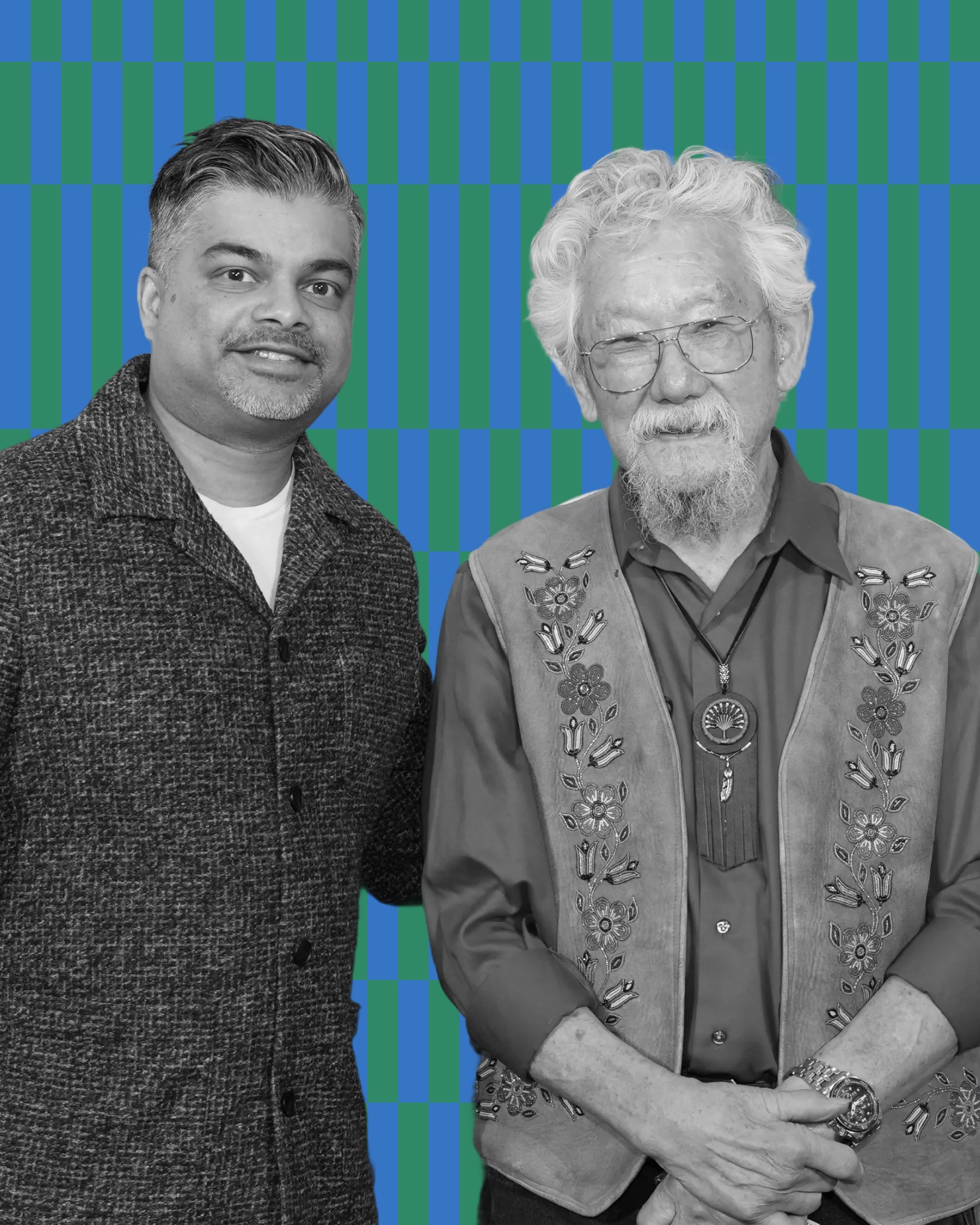
A few weeks ago I had the honour of attending a Canadian Club luncheon with Dr. David Suzuki and Dr. Tara Cullis in a clarifying moment for climate justice.
A few weeks ago I had the honour of attending a Canadian Club luncheon with Dr. David Suzuki and Dr. Tara Cullis in a clarifying moment for climate justice.
David and Tara’s work, through initiatives like the David Suzuki Foundation and Dr. Suzuki’s role as a journalist on shows like The Nature of Things on CBC, have long served as a reminder for Canadians of how precious and fundamental our relationship is with the greater ecosystem of our planet.
To put it as bluntly as Dr. Suzuki did, “we are a part of a community of organisms on who our very existence depends.” Dr. Suzuki has dedicated his life to sharing what science has told us—that our existence is being increasingly threatened by human-led changes to our planet over decades.
So what does it mean for us now? Again, turning to the science for the answers, Dr. Suzuki shared how his focus has shifted to community resiliency. The message, delivered to a pin-drop quiet audience I sat among, was clear. We are too late. We are in the era of living with extreme climate change—from flooding, to fires, to extreme cold and heat—and even those living in what were considered somewhat immune communities cannot escape the disruption and increasingly devastating results from our failure to take meaningful action that would have offset the impact we have made on our ecosystems.
Any stat alone that Dr. Suzuki shared that day—like that 7 of the 9 planetary boundaries essential to avoid abrupt or irreversible damage to Earth’s life-support systems have been surpassed—would be enough to terrify anyone into taking action. It’s in this context Dr. Suzuki urges us to think more about our own locality and community and ask ourselves, who will need support, who is most vulnerable, and what resources do we have (or will we need) for what will come.
When it was pointed out that he was labeled a ‘boy-who-cried-wolf’ by some critics, Dr. Suzuki paused and noted rightly that eventually, the wolf came.
Pressed further on what hope we have in the moment he’s outlined, he explained the possibility of any action lies in a context we cannot reconcile change with. In a reflection of his meeting with Prime Minister, Mark Carney, the day before, he noted that the government lacks the political will to make real change. Carney, whose book, Value(s), argues for values-driven economics in the face of crises like climate change, has shifted toward a stance that grows Canada’s oil and gas exports, including a memorandum of understanding that signaled renewed federal support for a pipeline corridor from Alberta to B.C.—a move that reignited unresolved questions of provincial and First Nations consent and reconciliation. The move was positioned as part of a broader strategy to bolster Canada’s economy at a time it’s facing pressure from United States tariffs.
Dr. Suzuki made the point that our continued interdependence in a capitalist model—where climate solutions only make sense if they create economic benefit—not only restricts us from making real change but is misguided. He shared that the prefix eco in both ecology and economy share the same root word; the Greek word oikos which translates to household or the place we live to illustrate how the economy is intrinsically and existentially is tied to the environment.
It’s a framing I’ve thought about often that seems to be missing from the discussions focused on economic stability in a time of geopolitical crisis. Climate solutions, along with other equity-focused initiatives from housing to food supply, are deprioritized without defining profitable market solutions to solve them.
Dr. Suzuki frames the challenge more clearly—that we don’t have life if we can’t even breathe for a few minutes. If our own atmosphere and environment become threats to our existence, measures like GDP or or market performance simply don’t matter. And as dire as that sounds, it is a reality for many communities around the globe, including developed countries who have historically been insulated from climate-related risk.
Shifting to the reality of community readiness as a climate strategy is one that is very much tied to the ideas of co-design. Through that lens, we can look to systems like neighbourhood land trusts, like the Parkdale Neighbourhood Land Trust or Chinatown Land Trust—both supported by With partners, Metcalf Foundation—as models for communal economies and resilience. Commons are an age-old, often unheralded model for sustainable ways of operating that can exist interdependently within socialist and capitalist models of societies.
Governments and private capital can subsidize these efforts in their own ways.
The BIA model, which matches municipal funding with business levies, dollar for dollar, is a form of socially supported commons for the betterment of Main St streetscapes and communities.
At With, we’ve looked to grant- and venture-backed models funded by private capital to develop digital platforms that can serve as resource library systems. (More on that in a separate post.)
The world Dr. Suzuki describes is not just inevitable—we are living in it. By having the courage to not just name that challenge, but also shifting our perspective of economic and ecological progress, we will more honestly address the ways we can address a climate future that will be increasingly dynamic. Focusing on community resilience, at the very least, will honour the legacy of the work of Dr. Suzuki and Dr. Tara Cullis who have dedicated their life's work to share the change we need, what’s at stake, and why it’s worth saving.
David and Tara’s work, through initiatives like the David Suzuki Foundation and Dr. Suzuki’s role as a journalist on shows like The Nature of Things on CBC, have long served as a reminder for Canadians of how precious and fundamental our relationship is with the greater ecosystem of our planet.
To put it as bluntly as Dr. Suzuki did, “we are a part of a community of organisms on who our very existence depends.” Dr. Suzuki has dedicated his life to sharing what science has told us—that our existence is being increasingly threatened by human-led changes to our planet over decades.
So what does it mean for us now? Again, turning to the science for the answers, Dr. Suzuki shared how his focus has shifted to community resiliency. The message, delivered to a pin-drop quiet audience I sat among, was clear. We are too late. We are in the era of living with extreme climate change—from flooding, to fires, to extreme cold and heat—and even those living in what were considered somewhat immune communities cannot escape the disruption and increasingly devastating results from our failure to take meaningful action that would have offset the impact we have made on our ecosystems.
Any stat alone that Dr. Suzuki shared that day—like that 7 of the 9 planetary boundaries essential to avoid abrupt or irreversible damage to Earth’s life-support systems have been surpassed—would be enough to terrify anyone into taking action. It’s in this context Dr. Suzuki urges us to think more about our own locality and community and ask ourselves, who will need support, who is most vulnerable, and what resources do we have (or will we need) for what will come.
When it was pointed out that he was labeled a ‘boy-who-cried-wolf’ by some critics, Dr. Suzuki paused and noted rightly that eventually, the wolf came.
Pressed further on what hope we have in the moment he’s outlined, he explained the possibility of any action lies in a context we cannot reconcile change with. In a reflection of his meeting with Prime Minister, Mark Carney, the day before, he noted that the government lacks the political will to make real change. Carney, whose book, Value(s), argues for values-driven economics in the face of crises like climate change, has shifted toward a stance that grows Canada’s oil and gas exports, including a memorandum of understanding that signaled renewed federal support for a pipeline corridor from Alberta to B.C.—a move that reignited unresolved questions of provincial and First Nations consent and reconciliation. The move was positioned as part of a broader strategy to bolster Canada’s economy at a time it’s facing pressure from United States tariffs.
Dr. Suzuki made the point that our continued interdependence in a capitalist model—where climate solutions only make sense if they create economic benefit—not only restricts us from making real change but is misguided. He shared that the prefix eco in both ecology and economy share the same root word; the Greek word oikos which translates to household or the place we live to illustrate how the economy is intrinsically and existentially is tied to the environment.
It’s a framing I’ve thought about often that seems to be missing from the discussions focused on economic stability in a time of geopolitical crisis. Climate solutions, along with other equity-focused initiatives from housing to food supply, are deprioritized without defining profitable market solutions to solve them.
Dr. Suzuki frames the challenge more clearly—that we don’t have life if we can’t even breathe for a few minutes. If our own atmosphere and environment become threats to our existence, measures like GDP or or market performance simply don’t matter. And as dire as that sounds, it is a reality for many communities around the globe, including developed countries who have historically been insulated from climate-related risk.
Shifting to the reality of community readiness as a climate strategy is one that is very much tied to the ideas of co-design. Through that lens, we can look to systems like neighbourhood land trusts, like the Parkdale Neighbourhood Land Trust or Chinatown Land Trust—both supported by With partners, Metcalf Foundation—as models for communal economies and resilience. Commons are an age-old, often unheralded model for sustainable ways of operating that can exist interdependently within socialist and capitalist models of societies.
Governments and private capital can subsidize these efforts in their own ways.
The BIA model, which matches municipal funding with business levies, dollar for dollar, is a form of socially supported commons for the betterment of Main St streetscapes and communities.
At With, we’ve looked to grant- and venture-backed models funded by private capital to develop digital platforms that can serve as resource library systems. (More on that in a separate post.)
The world Dr. Suzuki describes is not just inevitable—we are living in it. By having the courage to not just name that challenge, but also shifting our perspective of economic and ecological progress, we will more honestly address the ways we can address a climate future that will be increasingly dynamic. Focusing on community resilience, at the very least, will honour the legacy of the work of Dr. Suzuki and Dr. Tara Cullis who have dedicated their life's work to share the change we need, what’s at stake, and why it’s worth saving.
——
Subscribe to the With Journal
Get our news, reflections and event updates straight to your inbox.


